Measurement & Analytics
Dimensional Weighing & Logistics
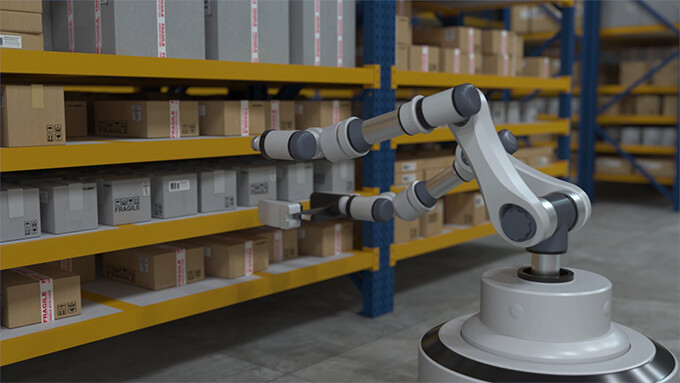
Freight, parcel, and warehouse operations price and route shipments based on dimensional weight — a calculation that’s only as good as the volumetric capture behind it. RealSense depth cameras generate point-cloud and aligned depth-to-color data fast enough to measure irregular, non-cuboid packages in motion on a conveyor or dock scale, without requiring the item to stop, rotate, or be manually placed against a backstop. Global-shutter sensor variants capture every row of the frame at the same instant, eliminating the motion blur and skew that rolling-shutter sensors introduce on moving belts — a prerequisite for dimensioning accuracy at line speed. That data feeds directly into billing, slotting, and load-planning systems through the same SDK used for static measurement, so operators aren’t maintaining two separate technology stacks for stationary and in-motion capture.
Volume & Portion Analytics
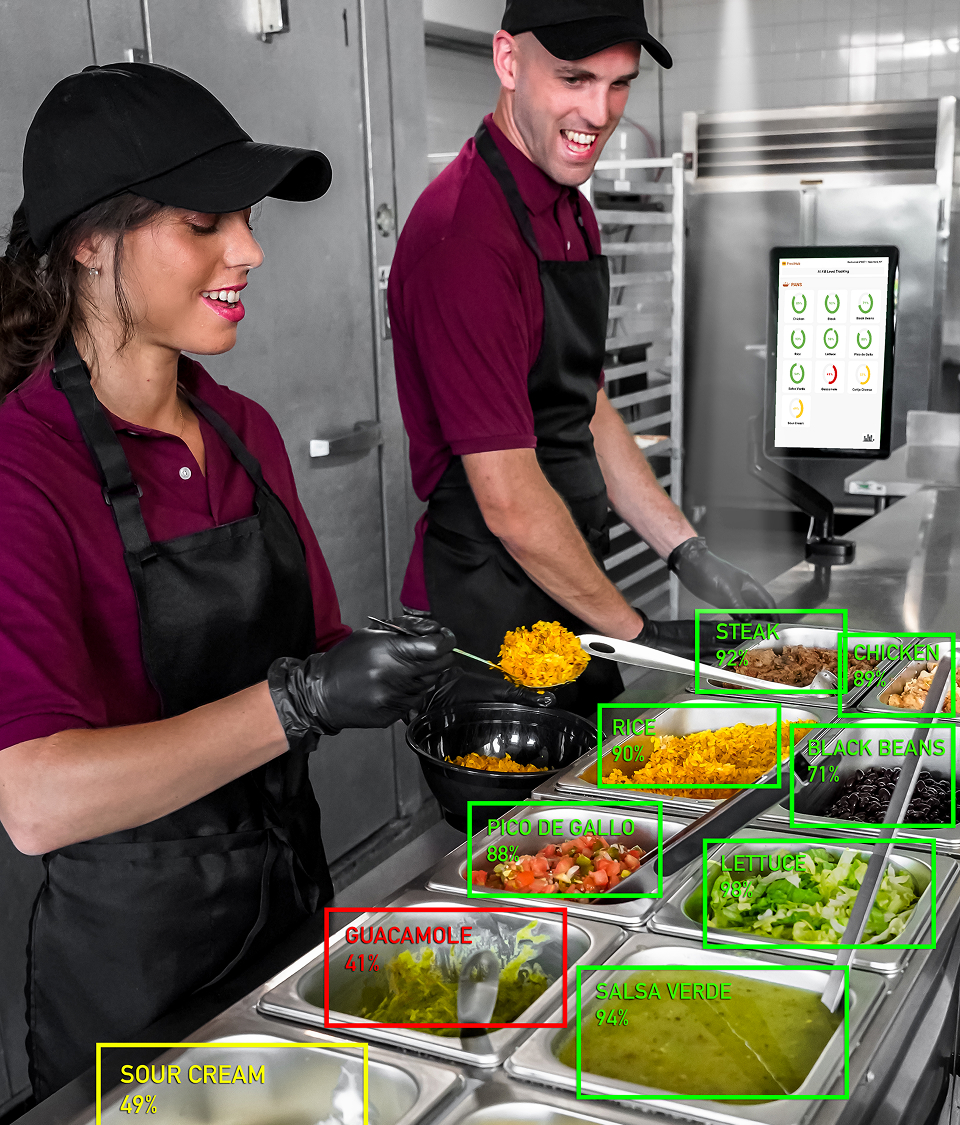
Estimating volume from a 2D image is a losing proposition — food service operators lose 30–40% of their inventory to overpreparation and waste precisely because manual counts can’t quantify irregular, constantly-changing shapes like scooped rice, ladled sauce, or shredded lettuce. RealSense depth sensors mounted overhead or above prep lines capture real depth data through glass hoods and display cases, locating target pixels and measuring the distance to the food surface to calculate remaining volume in real time. Integrated RGB alignment lets vision AI classify each ingredient and its container simultaneously, so a single sensor feed drives both “what is it” and “how much is left.” The result is inventory tracking accurate enough to trigger automated replenishment, cutting food cost and labor spend without adding headcount.
Anatomical & Body Measurement
Traditional fitting methods — Brannock devices, tape measures, subjective sales-floor judgment — can’t keep pace with the variation in human anatomy or the sizing inconsistency across manufacturers. RealSense stereo depth cameras capture high-resolution depth and color from multiple angles in a single sub-5-second scan, building a millimeter-accurate 3D model of a foot, limb, or other body region without physical contact. Paired with an AI matching engine, that data replaces guesswork with a measurement precise enough to recommend an exact size and shape match from a live product catalog. Retailers running this at scale report double-digit gains in conversion and meaningful reductions in size-driven returns.
Capture in Motion
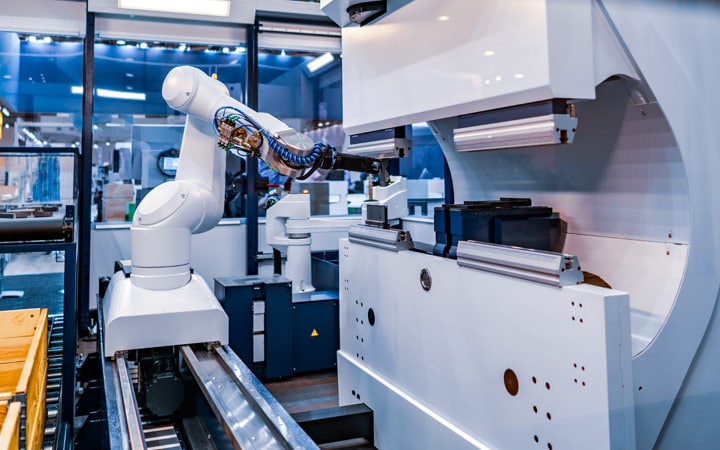
Most depth cameras are built for a subject that holds still. RealSense’s global-shutter models — including the D455 and the D500-series/D555 — are not. By exposing every pixel simultaneously rather than scanning row-by-row, they preserve geometric accuracy on moving targets — a part on an inspection line, a package on a belt, a limb that shifts mid-scan — where rolling-shutter sensors would introduce warping or blur. That same global-shutter design also improves the pixel-level correspondence between the depth stream and the RGB stream, which matters as much for classification accuracy as it does for motion tolerance: when depth and color are captured in lockstep, an AI model can trust that the volume it just measured belongs to the object it just identified.
Portability: Measurement That Goes to the Object
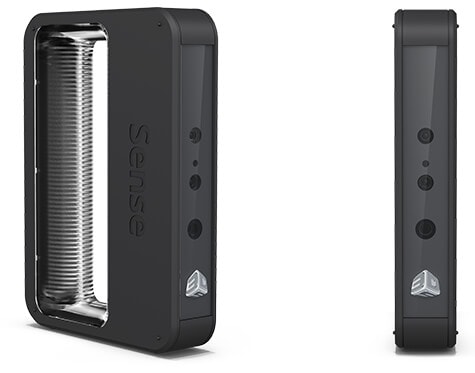
Not every measurement task can wait for the object to come to a fixed station. RealSense’s smallest cameras put dimensional accuracy in a handheld or field-mounted form factor: the D405, at 42 × 42 × 23 mm and roughly 60 g — smaller than a golf ball — delivers sub-millimeter accuracy at 7–50 cm ranges from a body-worn or handheld scanner, making it viable for mobile inspection, wound measurement, and close-range quality checks that a bench-mounted camera can’t reach. The same open SDK and calibration model that runs a fixed overhead sensor runs a handheld unit, so a measurement application isn’t rebuilt from scratch when it moves from a stationary line to a technician’s hand.
Flexibility: From a Single Bench to a Networked Line
Measurement deployments rarely stay small, and they rarely stay uniform. RealSense supports the connectivity a project actually needs rather than forcing every use case onto USB: GMSL/FAKRA interfaces (available on D400-series industrial variants) give industrial and robotics integrators automotive-grade, low-latency links over cable runs up to 15 meters, with native multi-camera synchronization across as many as eight cameras per system — built for the electrical noise and vibration of a factory floor rather than a desk. For deployments that need to scale across a warehouse or plant network, Ethernet and Power-over-Ethernet (PoE) variants stream depth and color over standard cable runs up to 100 meters, drawing power and data over the same line so a fleet of sensors can be added to existing network infrastructure without a parallel cabling project. Both paths run on the same underlying SDK as USB-connected cameras, so measurement and volume-analysis code written for one connectivity option carries over to the other.

Proven Accuracy, Built for the Field
A measurement system is only as good as its worst day on the floor — spilled liquids, dust, vibration, glare, a decade of unplanned events a lab test never accounts for. On-chip self-calibration keeps depth accuracy stable across a fleet of deployed cameras without a technician revisiting each unit, and ruggedized, industrial-grade housings — including IP65-rated enclosures resistant to dust ingress and projected water — let the same sensor run on a warehouse floor, a production line, or an outdoor loading dock that would degrade a consumer-grade camera within weeks. Volumental’s in-store scanners run non-stop through the kind of unplanned events an actual retail floor produces — spilled drinks included — and PreciTaste mounts its sensors above open food lines and behind glass hoods, reading depth through display cases and steam without dedicated shielding. In both cases, the operators cite the sensor’s reliability under real, messy conditions — not just its accuracy on a bench — as the reason the deployment scaled past a pilot.
Open-Source SDK for Custom Measurement Tools
RealSense measurement solutions are built on librealsense, the Apache 2.0–licensed, cross-platform SDK maintained on GitHub for the current D400 and D500 series depth cameras. Synthetic stream generation — point clouds, and depth aligned to color in either direction — gives developers the raw geometric data that volumetric and dimensional-weighing tools are built on top of, without writing a calibration or registration pipeline from scratch. The SDK repository ships working examples and wrapper integrations developers can build directly from:
- 3D reconstruction — wrappers/opencv/kinfu implements real-time volumetric reconstruction as a camera moves through a scene; examples/pointcloud and the wrappers/pcl integration cover point-cloud generation and further processing in the Point Cloud Library.
- Spatial analysis — examples/align and examples/align-advanced cover depth-to-color stream alignment and background segmentation built on it.
- Dimensional measurement — examples/measure shows the deprojection and calibration-intrinsics math (converting a pixel plus its depth value into a real-world 3D point) that dimensional-weighing and volumetric-measurement applications are built on. It’s published as a capability demo rather than a calibrated out-of-the-box measurement tool — production deployments layer additional filtering and calibration on top, the way Volumental and PreciTaste do in their own measurement pipelines.
Language and framework support includes C++, Python (pyrealsense2), C#/.NET, and Node.js, with integrations for ROS, ROS2, OpenCV, PCL, Unity, MATLAB, OpenNI, and Unreal Engine 4 — so measurement logic can be built directly into an existing robotics, inspection, or inventory stack rather than bolted on as a separate application.